
About SingleStory
Built from the ground up inside new-home sales.
Stefan Bean started SingleStory after more than twenty years in new-home sales, real estate and marketing, watching good teams relay the same answers by phone.
01 — The observation
Everyone was working. The buyer was still assembling the picture.
Working directly with homebuyers, the same pattern showed up on home after home. A buyer moves between sales, construction, financing and closing. Each person understands their own part of the work well. The buyer is the one left holding all of the pieces.
- Questions arrive in one channel and get answered in another.
- Dates, documents and updates live wherever they were first sent.
- Every participant answers accurately, from a different vantage point.
- The buyer stitches the answers together and hopes nothing was missed.
This is not a story about people who do not care, or teams that are not working. It is a story about a journey with no shared, buyer-centered layer holding it together.
Scenes like these:
- A sales consultant drives out to a home to see where construction stands before calling the buyer back.
- A superintendent catches a consultant in the community to ask them to set up an orientation.
- A Realtor calls three people to learn one closing date.
The answer existed. It just lived with someone else.
02 — The idea
One home. One shared record.
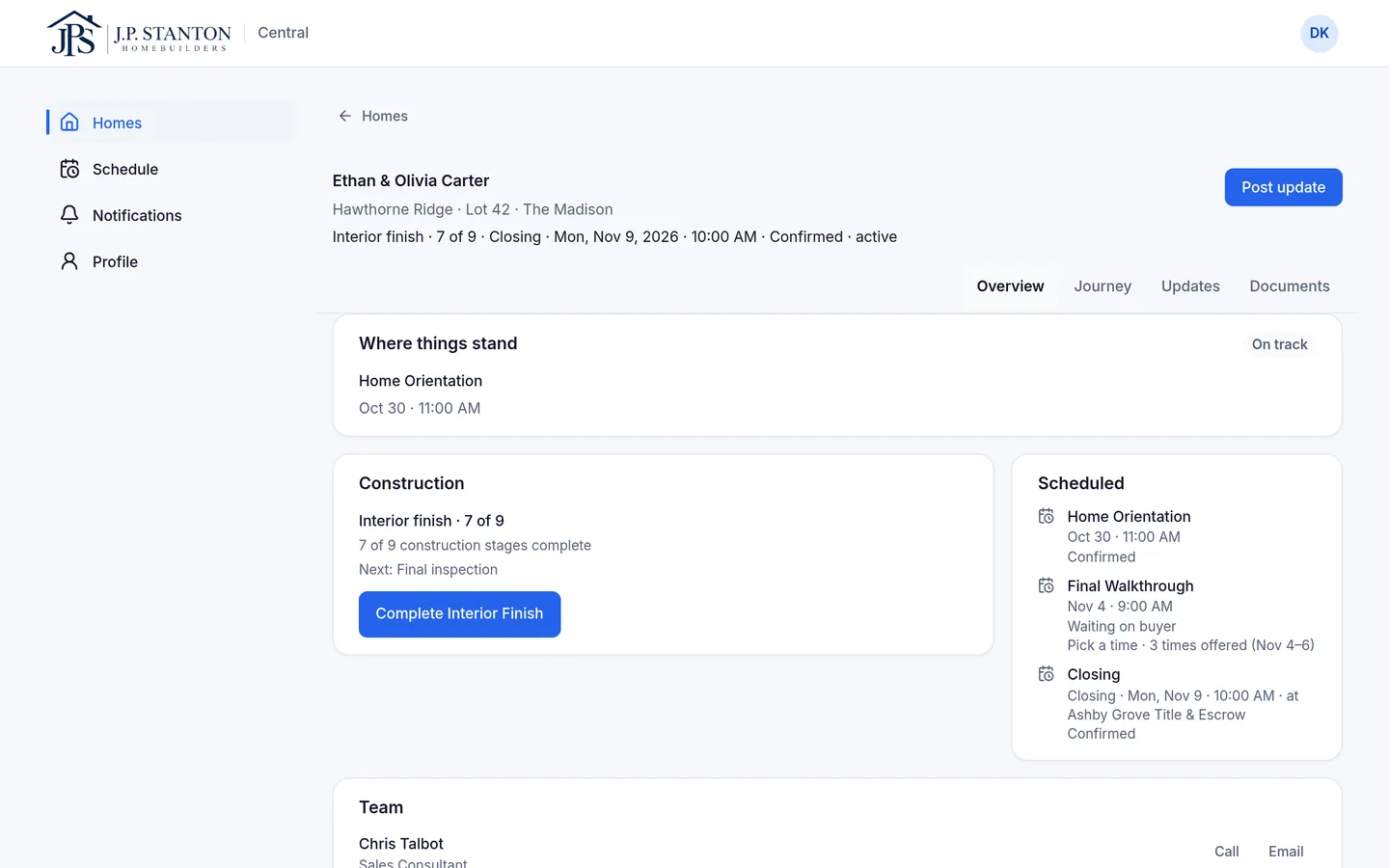
SingleStory organizes the home journey around the home itself. One shared record carries the home, the people responsible for it and what happens next — and each participant sees the part they own.
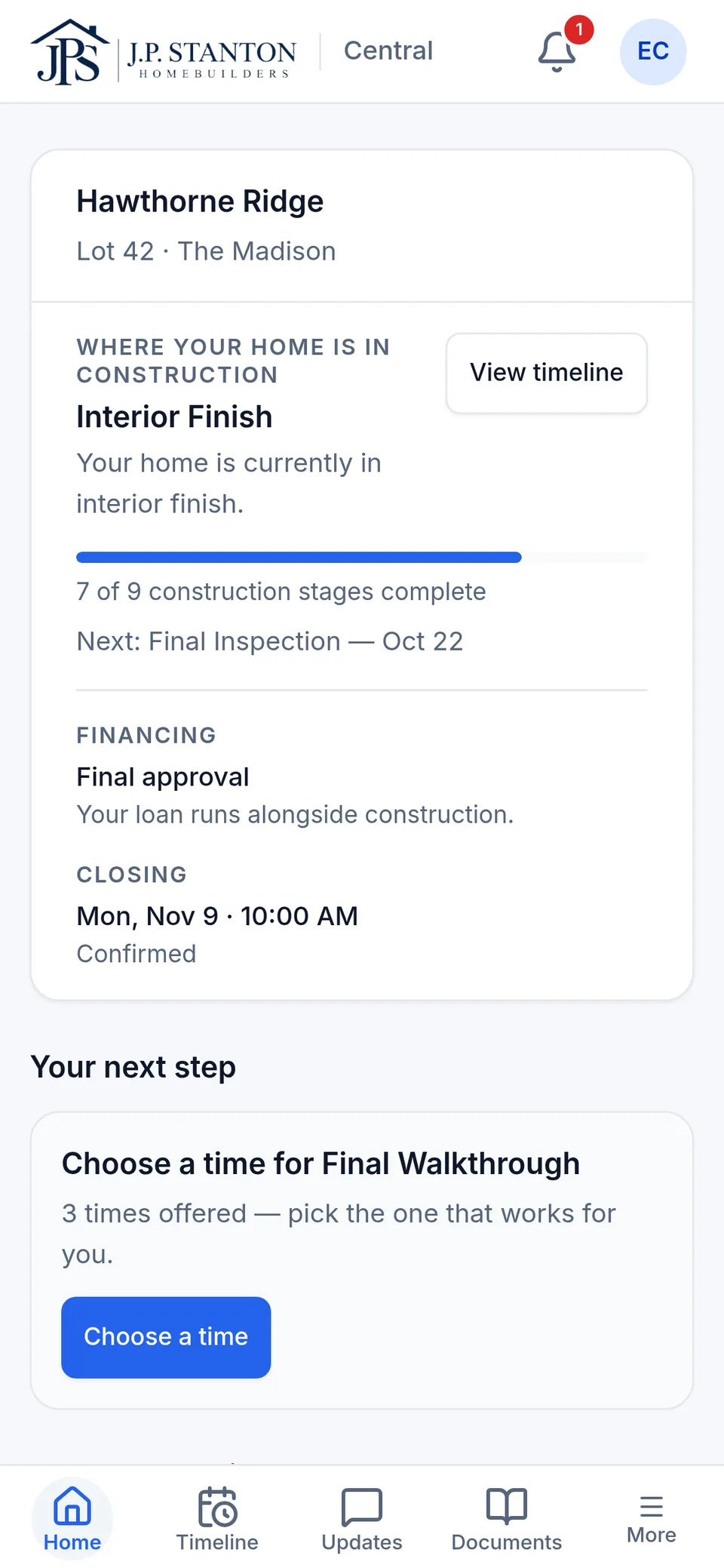
- The buyer sees where their home stands, what happened and what is needed from them.
- Each role keeps ownership of the answers they are actually responsible for.
- It complements the systems a builder already runs — CRM, ERP, construction and accounting — rather than replacing them.
- The builder stays the brand the buyer experiences. SingleStory stays in the background.
See the working product
Working software, not a slide.
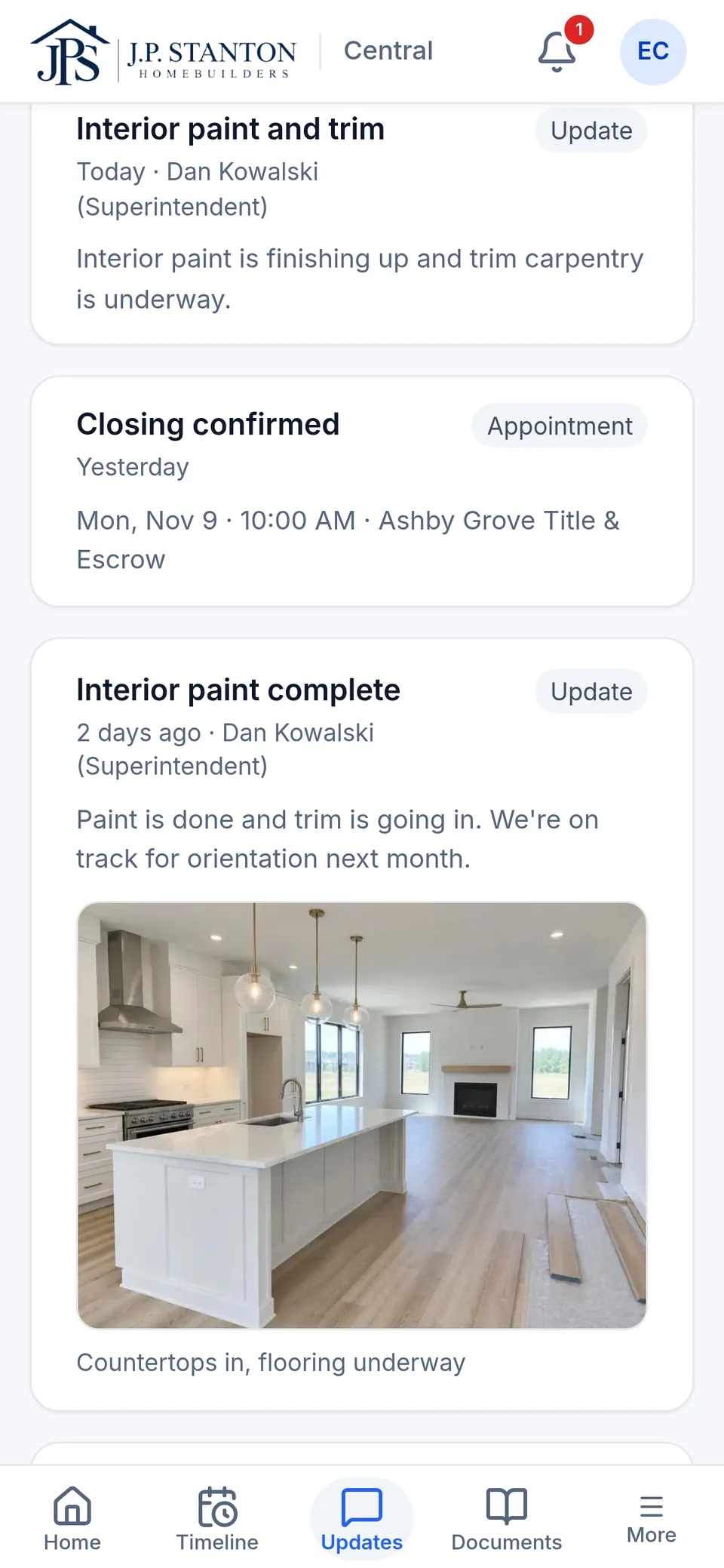
SingleStory is live software. Our demo builder, J.P. Stanton Homebuilders, runs on the same product a Founding Builder would use, with fictional buyers, homes and team.
Founder
Built from inside the journey.
More than 20 years across marketing, branding, design, real estate and new-home sales. Five of those years were spent as a REALTOR, and three working directly in new-home sales — alongside the people responsible for sales, construction, financing and closing.
That combination is the reason SingleStory looks the way it does. Brand work teaches how trust is built. Real estate teaches how buyers make the largest emotional and financial decision of their lives. New-home sales teaches what frontline teams have to explain and coordinate every week — and that a better buyer experience only survives if it is practical for the builder.
Running a small business for five years taught the rest: an idea is only useful when someone can actually operate it on a busy day.
SingleStory didn't come from looking for a software idea. It came from seeing the same problem, home after home.
SingleStory doesn't tell builders how to build homes. It helps everyone get on the same page while they do.
I kept seeing talented people working toward the same outcome while the buyer experienced the process as separate conversations. SingleStory began with the belief that the journey should feel as connected as the team building the home.
Eventually I started asking a simple question: why isn't the home itself what connects everyone?

Stefan Bean
Founder, SingleStory
Background
- More than 20 years across marketing, branding, design, real estate and new-home sales
- Five years as a REALTOR
- Three years working directly in new-home sales
- Helped more than 50 families purchase a new home in his first full year in new-home sales
- Owned and operated a small business with four employees for five years
Based in the Indianapolis, Indiana area.
What we believe
Four convictions behind the product.
The buyer should always know what happens next.
Progress, responsibility and the next step should be legible without a phone call.
Every answer should have an owner.
Clear ownership protects the buyer and the team. No question should belong to everyone at once.
Technology should connect the journey, not compete with the builder.
SingleStory sits alongside the systems a builder already runs and stays out of the relationship.
A home deserves one continuous story.
From contract through construction, financing and closing, the record of a home should not restart at each handoff.
03 — How SingleStory is being built
Deliberately, with a small number of builders.
SingleStory is selecting a limited group of Founding Builders to work with closely. The point is to run the platform in real operating environments, learn where it helps and where it gets in the way, and let that feedback shape practical refinements.
- Selective and collaborative — real adoption and operational learning, not enrollment numbers.
- Scope, support and expectations are agreed together before anything starts.
- An expression of interest starts a conversation; it is not an acceptance.
Let's put one of your homes on the same page.
Whether you build homes, advise the people who do, or want to understand where this is going — the next step is a conversation.